Showing posts with label biology. Show all posts

Sunday, 20 January 2013

Physics vs Biology in the Cure for Cancer

NCI Campus, Rockville, Maryland
From 2005-2012, the National Cancer Institute (NCI) in the US averaged an amount of $4.9 billion each year being put into cancer-related research.

Cancer Research UK spent £332 million on research activity in the 2011-2012 financial year.

Cancer research and treatment development consumes massive amounts of funding every year, but the cure for this universally-feared disease remains just out of reach.

Cancer cells, to a biologist, are pockets of chemical reactions and processes, capable of causing significant damage to healthy, living cells and genetic mutations in their cell recruits. Despite substantial funding which has fed into this all-important research, the US, for example, has seen a 5% decrease in cancer-related deaths since 1950. Although this is still an incredible number of lives saved, what more can be done to save future lives?

Perhaps the key to unlocking the mysterious fix lies with not a cancer biologist, but with a new type of mind - a physicist's mind.

In 2008, the NCI built 12 centres for physical science and oncology, designed for physicists, engineers and mathematicians to shed new light on cancerous cell behaviour.

Cells may be living things, but a physicist will consider other things than it's matter and behaviour: how about a cell's shape? Features in its structure such as pumps and levers? Properties of the membrane, the texture and design of the cell surface? "Many of these properties are known to change systematically as cancer progresses in malignancy."

Metastasis of the cancerous cells from the primary tumour.
Metastasis is the spread of cancer from its original position to another organ of the body. It is this which makes cancer so deadly.

Even if the primary tumour is removed, there is always the possibility that a new tumour could form and cause problems years later, due to a cancerous cell's ability to spread by entering the blood's circulation.

Four years after NCI proposed that physicists take a look at cancer, discoveries have been made concerning how the shape of a cancer cell changes during metastasis. Some are able to release "little molecular grappling hooks" or 'cadherins' to grip onto a blood vessel wall and 'nest' in the nearest organ.

Areolar extracellular matrix.
The new organ tissue may seem foreign but new research shows that cancer cells are able to alter the structure of the foreign organ's extracellular matrix - this section of tissue provides structural and defensive support to important tissues and organs.

So perhaps with the combined powers of biological and physical scientists, research for the treatment and ultimately cure for cancer will make some interesting leaps and bounds in the right direction. I think we should bring the three streams of science together more often (let's not forget Chemistry!), allowing different perspectives to be directed at the same problem. Surely things would be solved faster that way? No?

References: New Scientist, Wikipedia, National Cancer Institute, Cancer Research UK

Tuesday, 1 January 2013

The Downfall of the Dinos... How Much Do We Really Know?

I am co-founder of my school's e-newspaper, which myself and a few like-minded friends set up just over a year ago with the aim of sharing important, relevant and also not-so-relevant-and-frankly-quite-wacky news stories with our school.

I love being a part of this and even more so, I love being able to research scientific and engineering developments for our e-paper. (As a side note, if anybody enjoys writing, browsing the internet and having an excuse to frequently meet up with friends and chow down on snackage, I highly recommend starting one yourself!)

I volunteered to compose our last issue's Big Article for the front page and found out some pretty interesting stuff about the dinos. I thought you guys might be interested to know!

251 million years ago, at the end of the Permian period, 90% of the world’s species became extinct. Why?

The current dominating theory is that the mass extinction was caused by volcanic eruptions across a vast expanse of land, now known as Siberia. This theory has never fully satisfied scientists; Daniel Rothman from MIT has been studying Permian rock samples and has announced that carbon levels around this time increased too quickly to have been caused by merely volcanoes. A likely cause for the concentration of carbon compounds is microbes.

Rothman and his team analysed the genetic information of a microbe called Methanosarcina*, a methane-producing microorganism accountable for the majority of today’s methane and discovered that it developed its ability to generate methane about 251 million years ago.

One catch is that Methanosarcina needs huge quantities of nickel to produce methane at such a rate. Siberian lava is rich in nickel and nickel levels shot up almost exactly 251 million years ago, which seems to suggest that volcanic eruptions triggered the production of methane by the Methanosarcina, which in turn triggered the extinction of so many species.

Anthony Barnosky from the University of California says, “It's a fascinating idea that the evolution of a new life form led to an extinction.” We still don’t know what exactly happened all those years ago, but we are getting closer, one microbe at a time. I'm not sure which theory is most likely, but this is quite compelling, don't you think?

*Frankly, this is far too difficult to pronounce. I propose we nickname this microbe Jeffrey, or Orlando. Thoughts? :D

Saturday, 29 December 2012

GM Salmon Released Onto Our Plates

After much controversy and deliberation over a new species of genetically-modified salmon, this fish, American company Aqua Bounty's GM Atlantic salmon, is the first to be declared safe to grace our plates.


The US Food and Drug Administration (FDA) has recently revealed that it could not find any bona fide reasons for prohibiting the release of the GM salmon into the consumer market. The product currently poses no threat to human health, but, being a genetically-modified species, it's existence raises issues about any potential dangers.

Having completed my Geography GCSE at the end of the last school year, this topic piqued my interest. I had studied the 'GM Revolution' and investigated the advantages and disadvantages of such developments; in total honesty, the problems far outweighed the profitability. What I was interested to find out about was how the company behind the fish, Aqua Bounty, had managed to minimise any risks in order to reassure the FDA so well.

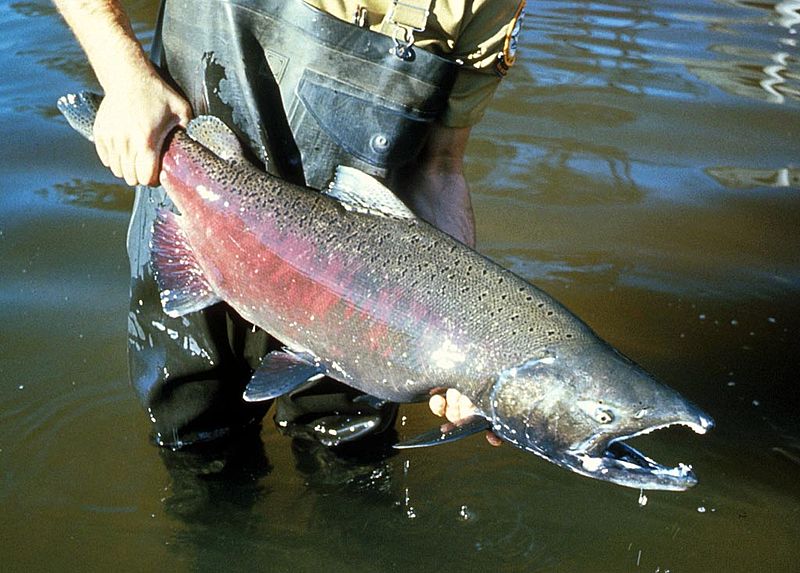
The genes of a wild Atlantic salmon were engineered with genetic material from the Pacific Chinook salmon and the Ocean Pout.


The Chinook salmon is more commonly known as the spring salmon, and is the largest of the salmon family. It's flesh is high in nutritional omega 3 fatty acids.


This 'eel-like species', the Ocean Pout, has "antifreeze proteins in its blood, giving it the ability to survive in near-freezing waters." Thus enabling the GM salmon to grow all through the year, as it is able to survive and feed in the colder seasons.

The new salmon is designed to live in inland fish-farms, reducing the risk of the GM species meeting its wild cousins out at sea. On the off-chance that the two do meet, the escapees would be unable to reproduce as they each have three copies of each chromosome, producing sterile female GM salmon. Due to the placement of the inland fish-farm tanks, the GM salmon will be closer to its destinations, therefore reducing transport costs and carbon emissions.

Currently, fish stocks and marine ecosystems are under extreme stress from overfishing and destructive fishing techniques. Pro-GM scientists argue that rearing the salmon in fish-farms will be much more environmentally-friendly.

A 'draft environmental assessment' was published last Friday, 21st December, announcing the GM salmon fit for human consumption. But with so many objections to genetically-modified products, who knows how well this particular fishy will swim?

Would you be happy eating GM foods?

References: Wikipedia, BBC News, The Independent

Wednesday, 18 April 2012

Lurking in the Depths... Shoot, My Biscuit Broke...

What is living in your PG Tips?
As I sit and write this, I have a steaming mug of milky tea beside my laptop. Over the past few months, I have grown more and more attached to the delightfully heart-warming beverage, thanks to Britain's cold snap in January-February, and Spring's belated arrival.

I have often heard that tea has many benefits, and heard even more often of its dangers. So I decided to investigate - what am I (and I'm sure, plenty of you) actually drinking?

The Good Stuff
White and green teas have the highest concentrations of antioxidants, but don't despair, black tea also has a substantial amount of them too. The specific antioxidant is called a catechin, pronounced "katt-eh-kin", I believe. Now, antioxidants, we hear about these all the time... but, if I'm honest, I'm as clueless about antioxidants as I am about quantum physics. Which is rather clueless to be frank, although I promise to master QP in a future post.

Antioxidants - molecules which inhibit oxidation of other molecules.

And oxidation is bad, so I'm warming to antioxidants. You see, oxidation is the loss of electrons from a substance, and these reactions produce free radicals.

Free radicals - atoms, molecules, ions with unpaired electrons, making them highly chemically reactive.

So these radicals start chain reactions in cells, catching the innocent cell unaware and fatally wounding it. Antioxidants stop these chain reactions by removing free radicals... by offering themselves up as juicy sacrifices to be oxidised by the radicals.

I sort of feel indebted to these antioxidants now...

Tea's antioxidant, the catechin, is also found in strawberries and some cocoa solids. Catechins are flavonoids - plant pigments which add the colour to their flowers. It can reduce the risk of 4 major health problems: stroke, diabetes, cancer and heart failure, apparently, but obviously, drinking 16 barrels of Earl Grey a day isn't going to make you invincible. You have to add routine exercise, balanced diet, banana face masks and a flowy red cape to the mix before you can really be invincible.

The Bad Stuff
Tea plants naturally absorb elements like fluoride and aluminium. Excessive amounts of fluoride leads to bone pains and fractures, whilst aluminium leads to an untimely death. But a mug of tea contains such small traces that you can wipe that anxious frown off your face.

And then, or course, there is caffeine. Some people live off the stuff, whilst others avoid it at all costs. Headaches and nausea are common symptoms of moderate caffeine intake, whilst long-term effects include the risk of developing cardiovascular and hepatic diseases. Oh, and diuresis, which, if you're not sure, means you pretty much have to carry your toilet around in your pocket all day (excessive urination).

Like most things, tea is a mix of good and bad, and I won't bore with the 'moderation' lecture. So, I'm off to microwave my mug now, as this post has taken long enough to freeze my tea into a brown ice lolly. Cheerio!